
Out of Gigs
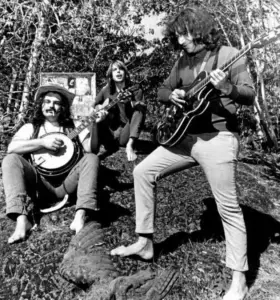
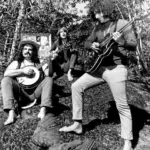
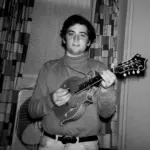
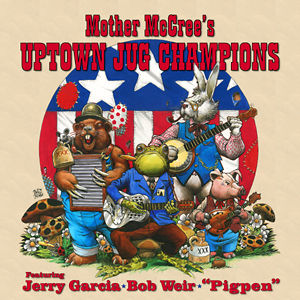
Through 1964 Mother McCree’s held down the Top of the Tangent, plus whatever parties and coffeehouses would book a jug band. Weir remembered the band becoming “fixtures” at the Tangent. Garcia remembered it differently: “We played any place that would hire a jug band, which was almost no place.” Both were probably right. The band was good and the crowds had fun, but a jug band had nowhere further to go. Members drifted off to school, and by the fall, Weir said, “we didn’t know what we were going to do.” The last known Mother McCree’s show was a hootenanny at the Peninsula YMCA on January 16, 1965.
The jug band year had changed the people in it. Weir had joined barely able to play guitar, so he was handed the jug and washtub bass. While Garcia was away on his bluegrass trip that spring, Weir took over Garcia’s beginner students at Dana Morgan’s Music Store, and he and Pigpen swept the floors there. Pigpen had become the member who, as David Nelson put it, made the band “really legitimate,” playing the harmonica parts on old jug band blues with perfect feeling. Garcia was tired of bluegrass. “I was kind of froze up in bluegrass,” he said, and the jug band had been a first step toward “just having fun, playing with your friends, not worrying about it being absolutely perfect.” Going electric would be the next step.
Pigpen pushed hardest. For months he had been after Garcia to start an electric blues band. As Lesh told it, Pigpen’s plan was simple: “Let’s get a drummer and make it an electric blues band.” Garcia knew where that would lead: “Theoretically it’s a blues band, but the minute we get electric instruments it’s a rock & roll band.”
Why They Went Electric
In 1963 the folk crowd around Garcia had dismissed the Beatles as lightweight pop. The film A Hard Day’s Night, released in August 1964, changed their minds. Sara Garcia remembered seeing “smart adorable talented guys our own age” getting to be silly on screen. Garcia saw musicians having fun and getting away with it: “You can be young, you can be far-out, and you can still make it.” Weir, the youngest of them, became the biggest Beatles fan of the group.
The Beatles were why we turned from a jug band into a rock & roll band. What we saw them doing was impossibly attractive. I couldn’t think of anything else more worth doing.
Bob Weir
The Rolling Stones showed them how to do it. The Stones were playing the Chess Records blues that Garcia and Pigpen had grown up on: Muddy Waters, Howlin’ Wolf, Jimmy Reed, Chuck Berry. “We were kind of patterned along the same lines as the Rolling Stones,” Garcia said. When it came to choosing covers, “we always opted for whatever the Rolling Stones were doing, because we had a better understanding of where the music was coming from.” The Beatles’ songs, Weir said, “were untouchable.”
Bob Dylan supplied the last push. As a folkie, Garcia had found Dylan hard to take. Bringing It All Back Home, released in March 1965 with one side backed by an electric band, won him over. He played “It’s All Over Now, Baby Blue” “over and over and over again,” and the Warlocks were soon covering it, with Weir singing Dylan’s “She Belongs to Me.” By early 1965 Garcia’s circle had also started taking LSD, and Sara said afterward that “the resistance to amplified music waned.”
For Garcia the switch was personal too. After years of drilling bluegrass banjo, the electric guitar felt like a release. “Playing the electric guitar represented freedom from the tremendous control trip that you have to have to be a banjo player,” he said.
The Music Store Band
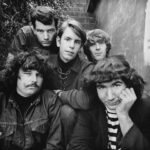
The Warlocks came together around New Year’s 1965, built almost entirely from the staff of Dana Morgan’s Music Store. Garcia taught guitar and banjo there, Weir taught beginners, and Pigpen swept up. Bill Kreutzmann, the store’s drum teacher, had more rock and roll experience than any of them, and Garcia already knew him. He had bought a banjo from Kreutzmann years earlier, and they had crossed paths around the Zodiacs. Garcia called him “the fastest, most heaviest rock & roll drummer in Palo Alto.” Kreutzmann was eighteen and in his last year of high school, already married with a baby daughter and selling wigs to pay the bills. He got into the band’s first bar gigs on a fake draft card under the name Bill Sommers. The bass player was the owner’s son, Dana Morgan Jr. He offered to lend the band the store’s electric instruments if he could play bass.
So the first rehearsals happened after hours, on guitars and amps taken down from the store’s walls. Pigpen sang lead on nearly everything and played organ. A song list he wrote out for the band reads like his record collection: Jimmy Reed, Chuck Berry, Bo Diddley, and the Stones’ versions of American blues. They learned songs off 45s on a cheap phonograph on the counter, while Weir’s classmate Sue Swanson, the band’s first fan, moved the needle back for another pass. One musician remembered Garcia in his teaching alcove, working out Keith Richards’s solo on “Heart of Stone” and running out shouting “I got it!” Garcia also ran rehearsals hard. David Nelson stopped by and heard him yelling at Weir, “No, no, no, not like that, you goony child!” Everyone was laughing, Nelson said, and Weir “hung in there and got better.”
Magoo’s
After months of rehearsing, the Warlocks talked their way into Wednesday nights at Magoo’s Pizza Parlor on Santa Cruz Avenue in Menlo Park, starting May 5, 1965. There was no stage, so they set up against the front window. Garcia, still playing like a folkie, sat on a stool facing Weir instead of the crowd, until Swanson and her friend Connie Bonner told him to stand up and play rock and roll. Garcia remembered almost nobody showing up the first week. By the third, word had spread through the local high schools, the place was packed and kids were dancing on the sidewalk. “None of us expected that kind of reception,” Garcia said. “We caught fire right away.” Around the same time they played a mixer at the Menlo School student union, where one student remembered Pigpen out front on “Big Boss Man” and “In the Midnight Hour.”
The crowds were the problem. The Magoo’s run ended in late May. In one account, neighboring shops complained about kids blocking the sidewalk; Lesh heard that people “just wouldn’t stop dancing.” By then the band had found its bass player in the audience.
Phil Learns the Bass
Phil Lesh had stopped writing music. After Foci he felt he had composed himself into a corner. By the spring of 1965 he had quit driving a mail truck and was living in the Haight-Ashbury, letting his hair grow. For the first time he was listening seriously to rock and roll. He saw the Rolling Stones at the San Francisco Civic Auditorium on May 14, and their single “The Last Time” got him curious about the bass. At a party not long before, he had mentioned to Garcia that he might like to play an electric instrument, maybe bass.
When he heard Garcia had a band, Lesh and a carload of friends drove down to Magoo’s. “Pigpen ate my mind with the harp, singing the blues,” he said. At the set break Garcia took him aside: “Our bass player is not a musician, and we have to tell him what notes to play.” Lesh said he would give it a try.
On June 7 he moved into a communal house on Gilman Street in Palo Alto, full of Garcia’s bluegrass friends. Eric Thompson, David Nelson and John Dawson each showed him the basics of a fretted instrument. Lesh practiced constantly, first on a borrowed guitar and then on a single-pickup Gibson bass that his girlfriend bought him at Guitars Unlimited in Menlo Park. “When I first played an electric instrument, I played it for seven hours straight, and I couldn’t sleep that night,” he said. Garcia’s coaching was mostly about feel. He said he showed Lesh “the sense of the bass for each tune,” and Lesh figured out the rest. About two weeks later he played his first gig.
Lesh’s arrival cost the band its rehearsal room. Dana Morgan Jr. was out of the band, and his father, who had never liked the noise, took the equipment back. The band scrambled for gear. Garcia’s mother lent him the money for the red Guild Starfire he would play for the next two years. Weir chose a Gretsch, partly because George Harrison played one. Rehearsals moved to the back room at Guitars Unlimited, where Garcia and Weir now taught, and to friends’ living rooms, garages and back yards.
Featured Songs
| Song | Album(s) | Released | Band | Live Plays | Debut | Original | Lyrics | Guitar | Fans | Recordings |
|---|---|---|---|---|---|---|---|---|---|---|
| In the Midnight Hour | Dec 31, 1982 | The Grateful Dead | 141 | December 27, 1970 | Wilson Pickett | |||||
| I Know You Rider |
 Europe ’72
 Hundred Year Hall
 Fare Thee Well
|
Nov 3, 1965 | The Grateful Dead | 1525 | November 3, 1965 | |||||
| Caution (Do Not Stop on Tracks) |
 Anthem of the Sun
 Rare Cuts & Oddities 1966
|
Jul 18, 1968 | The Grateful Dead | 168 | November 3, 1965 | |||||
| It's All Over Now Baby Blue | Jan 7, 1966 | The Grateful Dead | 203 | January 7, 1966 | Bob Dylan | |||||
| I'm A King Bee |
Rare Cuts & Oddities 1966
|
Jan 8, 1966 | The Grateful Dead | 60 | January 8, 1966 | Slim Harpo |
Hayward and the Bar Circuit
Their first gig with Lesh, at Frenchy’s in Hayward in mid-June, was a disaster. “There were about three people there,” Lesh remembered, and two of them were Swanson and Bonner. When the band came back the next night, a trio with saxophone, accordion and guitar had taken their place. Pigpen may not have played at all. Swanson, too young to get in, spent the evening in Kreutzmann’s station wagon with him while he told her the whole story of The Hobbit.
Garcia kept them rehearsing almost every day anyway, and over the summer a booking agent named Al King started placing them in clubs along El Camino Real. They won a battle of the bands at the Cinnamon Tree, a teen club in San Carlos. They played Big Al’s Gashouse and the Fireside Lounge in San Mateo, where the job was to keep people dancing and drinking. The repertoire was what bar bands played in 1965: Rolling Stones songs, Chuck Berry, “Gloria,” “Wooly Bully,” and the Lovin’ Spoonful’s “Do You Believe in Magic,” a Lesh favorite after the band saw the Spoonful in August. Pigpen’s blues, like “I’m a King Bee” and “Little Red Rooster,” stayed at the center of the set.
The In Room
In September the Warlocks landed their first real residency: six weeks at the In Room, a lounge in Belmont, playing five fifty-minute sets a night, five nights a week. For the first week they backed the Coasters. The Coasters’ musical director, who doubled on rhythm guitar, tried to teach them the songs onstage, though Garcia, who loved the Coasters, already knew them. After that the room was theirs. With a short song list and long nights to fill, the songs started getting longer. “We had started out by expanding tunes through extended solos, mainly to make them last longer since there were so few of them,” Lesh wrote. Weir said the first thing he learned was “to rattle on in one chord change for a while, until we were done punching it around.” One night they stretched Wilson Pickett’s “In the Midnight Hour” across an entire forty-five-minute set.
This is where five very different musical backgrounds started to fuse. Lesh, the Coltrane fan, heard in a one-chord groove the same open space Coltrane improvised over. He turned Kreutzmann on to Coltrane’s drummer, Elvin Jones, who Kreutzmann later said taught him “freedom, total freedom of expression.” Kreutzmann’s dance-band instincts kept the floor moving underneath. Garcia, used to trading leads in bluegrass bands, took the long solos, and Weir, still learning, found his place in the spaces around them. Pigpen held the center with the blues. “We learned that we could make one song last an entire set,” Kreutzmann said. By late October the Warlocks were drawing a different crowd to the late sets: young freaks who came for the band, not the bar.
Featured Shows
| Show | Date | City/Country | Venue | Band | Songs | Tour | Fans |
|---|---|---|---|---|---|---|---|
| Palo Alto – July 16, 1964 | Jul 16, 1964 | Palo Alto, California, United States | Top Of The Tangent | — | ? | — | — |
| Palo Alto – July 17, 1964 | Jul 17, 1964 | Palo Alto, California, United States | Top Of The Tangent | — | ? | — | — |
| Palo Alto – July 18, 1964 | Jul 18, 1964 | Palo Alto, California, United States | Top Of The Tangent | — | ? | — | — |
| San Francisco – November 3, 1965 | Nov 3, 1965 | San Francisco, California, United States | Golden State Studios | The Warlocks | 6 | — | — |
| Hayward – June 18, 1965 | Jun 18, 1965 | Hayward, California, United States | Frenchy's | — | ? | — | — |
First Songs and a New Name
By October the band knew it needed songs of its own. The Family Dog, a new collective throwing dances in San Francisco, had turned the Warlocks down for being only a cover band. The originals came quickly, and from several directions. “Caution (Do Not Stop on Tracks)” grew out of a riff Weir said they lifted from Them’s “Mystic Eyes,” with Pigpen making up the words. Lesh wrote most of the lyrics to “Mindbender,” Garcia wrote the words to “Can’t Come Down,” and, according to David Nelson, Dave Parker, the jug band’s washboard player, supplied the lyrics to “The Only Time Is Now.”
On November 3, 1965, the band recorded those four songs and two covers, “I Know You Rider” and “Early Morning Rain,” as a demo for Autumn Records at Golden State Recorders in San Francisco. Nothing came of it at the time, and the six tracks stayed unreleased until Birth of the Dead in 2003. They are the only recordings of the band before it became the Grateful Dead. What they capture is a garage band with folk-rock ambitions, still a long way from the music it would make a year later. The session was booked under the name the Emergency Crew, because the band had learned that another group was already putting out records as the Warlocks.
The new name came that fall at Lesh’s house on High Street in Palo Alto, when Garcia opened a dictionary. Lesh remembered it as a Britannica World Language Dictionary; other accounts point to the Funk & Wagnalls folklore dictionary. On the page was “grateful dead,” a folk-tale motif:
The Grateful Dead
The motif of a cycle of folk tales which begin with the hero’s coming upon a group of people ill-treating or refusing to bury the corpse of a man who had died without paying his debts. He gives his last penny, either to pay the man’s debts or to give him decent burial. Within a few hours he meets with a traveling companion who aids him in some impossible task, gets him a fortune, saves his life, etc. The story ends with the companion disclosing himself as the man whose corpse the other had befriended.
The name came straight out of the folk tradition the band had just left behind, and it didn’t sound like any other rock band of 1965. The new name suggests a band looking both backward to traditions and forward into experimental territory. “Grateful Dead” evoked from the folk world, and it wasn’t a name that fit naturally into rock conventions. It was a name that indicated this band would remain rooted in American vernacular traditions even as they explored electric rock.
To understand what the Grateful Dead became we must understand their roots in folk, bluegrass, and blues traditions. A band that valued improvisation, ensemble democracy, emotional authenticity, deep repertoires, respect for tradition, and community emphasis. They inherited these from American musical traditions, amplified them through electric rock, and expressed them throughout their career. The band’s genius lay not in creating something entirely new but in taking deep traditions and proving that tradition and innovation could not only coexist but could produce something genuinely transcendent – and have fun doing it.
To the Acid Tests
While the Warlocks worked the bars, Garcia’s old Peninsula circle was drifting toward Ken Kesey. Kesey had moved from Perry Lane to La Honda, and his Merry Pranksters were planning LSD parties with live music. Lesh and Weir rode the Pranksters’ bus to see the Beatles at the Cow Palace on August 31. Some of the band went to the first Acid Test, a private gathering in Soquel in late November, “not to play, but just to feel it out,” as Lesh put it. On December 4, 1965, the Rolling Stones played the San Jose Civic Auditorium, and the Pranksters handed flyers to the crowd leaving the show asking, “Can you pass the acid test?” That night the band played an Acid Test at a house in San Jose. It was their first show as the Grateful Dead. Six days later they played the second Mime Troupe benefit at the Fillmore Auditorium.
In less than a year, a jug band without gigs had become a working electric band with its own songs, a new unique name, and the habit of stretching a single groove until it turned into something new.