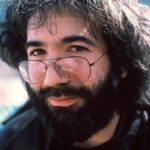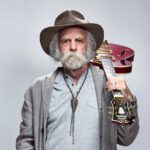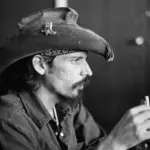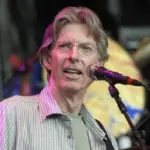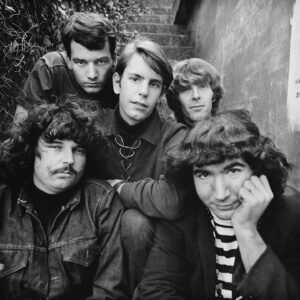

The Grateful Dead were an American rock band formed in the San Francisco Bay Area in 1965, emerging from the same countercultural scene that would soon make Haight-Ashbury synonymous with the psychedelic era. Led by guitarist and vocalist Jerry Garcia, the band—Bob Weir (guitar, vocals), Ron “Pigpen” McKernan (keyboards, harmonica, percussion, vocals), Phil Lesh (bass, vocals), and Bill Kreutzmann (drums)—quickly distinguished itself from its contemporaries through a willingness to improvise, experiment, and let songs evolve from performance to performance. Their music drew from an unusually broad range of traditions, including blues, folk, country, bluegrass, jazz, rhythm and blues, and psychedelic rock.
Over the next three decades, the Grateful Dead developed into one of the most influential live bands in American music. Their concerts became the center of a devoted community of fans known as Deadheads, and their improvisational approach made no two performances quite alike. The band continually expanded its musical palette, most notably through the addition of second drummer Mickey Hart, keyboardists Tom Constanten, Keith Godchaux and Brent Mydland, and vocalist Donna Jean Godchaux, among others. Despite numerous lineup changes, the Dead maintained an extraordinary continuity around Garcia, Weir, Lesh, Kreutzmann and, for most of the band’s history, Hart. The Grateful Dead performed their final concert in July 1995, following Garcia’s death the following month, bringing an end to one of the longest-running and most singular creative partnerships in rock history.
Grateful Dead went through many changes and eras over the years, but remarkably, the band’s core remained together for nearly its entire 30-year career. When the group emerged from the San Francisco scene in 1965, its founding lineup consisted of Jerry Garcia (lead guitar, vocals), Bob Weir (rhythm guitar, vocals), Ron “Pigpen” McKernan (keyboards, harmonica, percussion, vocals), Phil Lesh (bass, vocals), and Bill Kreutzmann (drums). The first major expansion came in September 1967, when Mickey Hart joined as a second drummer. Hart’s interest in polyrhythms and percussion dramatically expanded the band’s rhythmic vocabulary, and his partnership with Kreutzmann became one of the defining features of the Dead’s sound.
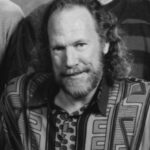
In late 1968, the Dead added another musician without removing anyone: Tom “T.C.” Constanten joined as a second keyboardist alongside Pigpen. A classically trained musician and former classmate of Phil Lesh at Mills College, Constanten brought a more avant-garde, electronic and orchestral sensibility to the increasingly psychedelic band, contributing to Aoxomoxoa and Live/Dead. Pigpen, meanwhile, remained an important member, increasingly emphasizing his singing, harmonica and percussion as Constanten handled more of the keyboard duties. Constanten left in early 1970 by mutual agreement following the band’s New Orleans drug bust, returning the group to a six-piece lineup.
The next change was more difficult. In February 1971, Mickey Hart took an indefinite leave from the band after his father, Lenny Hart, who had briefly managed the Grateful Dead, was discovered to have embezzled a substantial amount of the group’s money. The episode was deeply painful for Hart, and his own struggles with drugs compounded the situation; he ultimately withdrew from the band and returned to his ranch in Novato. Bill Kreutzmann consequently became the Dead’s sole drummer for more than three years. Hart would eventually return permanently in October 1974, restoring the band’s two-drummer configuration.
Meanwhile, Ron “Pigpen” McKernan’s health had deteriorated significantly, largely as a consequence of years of heavy drinking and the resulting liver problems. After becoming too ill to tour regularly in 1971, Pigpen was joined by pianist Keith Godchaux, who brought a fundamentally different keyboard voice to the band. Godchaux’s acoustic piano complemented Pigpen’s Hammond organ rather than immediately replacing it, and for a period the two occupied distinct musical roles. Keith’s wife, Donna Jean Godchaux, a veteran Muscle Shoals session singer, joined the Dead as a vocalist in early 1972, adding a new female harmony voice to the group. Pigpen’s final concert was June 17, 1972; he died in March 1973 from complications associated with liver damage. His passing marked the end of the original five-member configuration that had formed the heart of the band in the 1960s.
The return of Mickey Hart in October 1974 completed one of the Dead’s most enduring lineups: Garcia, Weir, Lesh, Kreutzmann, Hart, Keith Godchaux and Donna Jean Godchaux. This seven-member configuration carried the band through the Blues for Allah, Terrapin Station and Shakedown Street eras and through some of the most celebrated performances of the 1970s. Keith’s piano became an integral part of the Dead’s increasingly spacious and jazz-influenced sound, while Donna Jean’s vocals gave the band a distinctive additional harmonic color. The lineup finally changed in February 1979, when Keith and Donna Jean left the band by mutual agreement. The relentless touring schedule had taken a heavy toll on the couple, and both were experiencing significant personal and musical difficulties. They subsequently turned their attention toward making music together outside the Dead.
Brent Mydland became the Dead’s new keyboardist and vocalist, making his debut on April 22, 1979. Mydland had previously played with Bob Weir’s band, Bobby and the Midnites, and brought a powerful, soulful keyboard style and a distinctive voice to the group. His tenure lasted more than eleven years, encompassing the transition from the late-1970s period through the band’s enormous late-1980s resurgence. Mydland also became an increasingly important songwriter and vocalist, contributing songs including “Far From Me,” “Easy to Love You,” “Hell in a Bucket” and “Just a Little Light.” His tenure ended tragically on July 26, 1990, when he died from an accidental drug overdose at the age of 37.
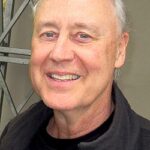
The final major lineup change came in the aftermath of Mydland’s death. Vince Welnick, formerly the keyboardist and vocalist for the Tubes, was selected as the Dead’s new full-time keyboardist, making his debut on September 7, 1990. To help fill the enormous musical space left by Mydland and to give Welnick time to become familiar with the band’s extensive repertoire, pianist Bruce Hornsby also joined the touring lineup. Hornsby had already been a friend and occasional collaborator of the band, and although he declined a permanent position because of his own career, he performed more than 100 shows with the Dead between 1990 and 1992. Hornsby eventually stepped away to concentrate on his solo career and spend more time with his family, while Welnick remained the band’s keyboardist.
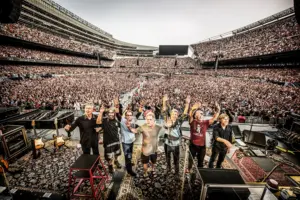
The resulting final touring lineup—Jerry Garcia (guitar, vocals), Bob Weir (guitar, vocals), Phil Lesh (bass, vocals), Bill Kreutzmann (drums), Mickey Hart (drums, percussion), and Vince Welnick (keyboards, vocals), with Bruce Hornsby appearing as a touring member until 1992—remained together until Garcia’s death in August 1995. The Grateful Dead played their final concert at Soldier Field in Chicago on July 9, 1995. Although the band’s personnel had changed considerably around the edges, Garcia, Weir, Lesh, Kreutzmann and, for most of the era, Hart had provided an extraordinary continuity. Rather than simply replacing musicians, the Dead repeatedly absorbed new musical voices and allowed them to reshape the sound of the group. That willingness to evolve—while preserving the improvisational identity at its center—was one of the defining characteristics of the Grateful Dead.
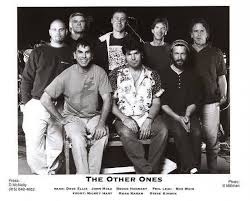
Jerry Garcia’s death in August 1995 brought the Grateful Dead’s original era to a close, but it did not bring an end to the music, the community, or the culture that had grown around the band. Deadheads and former members found different ways to carry that legacy forward, from Phil Lesh & Friends and Bob Weir’s RatDog to The Other Ones and Furthur, as well as later collaborations such as Dead & Company and the various projects involving other former members. Alongside these successor bands, a vast and continually renewing tribute-band scene has emerged, with groups ranging from local bar and festival acts to nationally touring ensembles devoted to recreating the Dead’s repertoire and live experience. New tribute bands continue to form decades after Garcia’s passing, ensuring that the songs remain part of the living musical landscape rather than simply a relic of the past. In that sense, the Grateful Dead’s story did not truly end in 1995: it fragmented, evolved, and multiplied into an enduring musical tradition carried forward by former members, successor groups, and generations of musicians and fans who never had the opportunity to see Garcia perform with the original band.