
Can You Pass the Acid Test?
A week after their first night under the new name, the Grateful Dead were back at Ken Kesey’s side for the Muir Beach Acid Test on December 11, 1965, and a week after that at the Big Beat in Palo Alto. At an Acid Test, Kesey’s Merry Pranksters filled a hall with strobe lights, film loops, tape machines and microphones anyone could grab, and the LSD was free. The band set up in a corner and played when it felt like playing. “The Acid Test was a place where you could take acid, or not, and play music, or not,” Kreutzmann said.
For a band that had just spent six weeks doing five sets a night in a Belmont lounge, it was freedom. Nobody needed them to finish a song or play one they knew. “We could play anything we could think of, which meant we didn’t have any constraints on our performance,” Garcia said. Some nights that fell apart. On others it opened something up, and Garcia later called the Acid Test “the prototype for our whole basic trip.”
The Acid Tests moved into the city in January 1966. On January 8, at the Fillmore Auditorium, Prankster Ken Babbs ran a tape recorder while the band worked through Pigpen’s “I’m a King Bee” and “Hog for You Baby,” the Warlocks’ original “Caution (Do Not Stop on Tracks)” and “Death Don’t Have No Mercy.” Late in the night everyone was told to clear out, and the announcements are on the tape. Two weeks later the band played the Trips Festival at Longshoremen’s Hall, the three-night event that drew thousands of people to the Acid Test idea.
The Babbs tape has long been called the earliest live recording of the Grateful Dead. Its date and venue have recently been questioned, so it’s safest to call it the earliest live tape traditionally dated to January 8, 1966.
Earliest Known Recording

Los Angeles on Owsley’s Dime
One of the people at the Acid Tests was Augustus Owsley Stanley III, known as Bear, the Bay Area’s best-known LSD chemist. He had fallen for the band at the Acid Tests and decided to back it. In February 1966 he moved the band and its friends, about a dozen people, to Los Angeles to follow Kesey’s Pranksters south. They lived in a big house on West Adams Boulevard near Watts. Owsley paid the rent, bought the food and put everyone on an all-meat diet. Neighbors called the police about the rehearsals. “He was our patron, in the ultimate sense of the word,” Lesh said. “He never once thought about the money. We were able to be the Grateful Dead.” Kreutzmann put it more simply: “He bought us clothes and food. We didn’t have to have day jobs.”
The band played the Los Angeles Acid Tests, including Watts on February 12 and the Pico Acid Test on March 19, which the building’s owner shut down before midnight. Owsley also appointed himself the band’s sound engineer. He built a heavy, experimental PA, tried tricks such as wiring pairs of stage microphones out of phase to cancel feedback, and taped many of the shows. The rig took hours to set up, which drove the band crazy, but sound quality became a Grateful Dead obsession for the next thirty years.
The best tapes from Los Angeles show the band’s repertoire growing. Next to Pigpen’s blues there was “Viola Lee Blues,” “I Know You Rider,” “Beat It on Down the Line” from the jug band days, the Reverend Gary Davis song “Death Don’t Have No Mercy,” and a long Wilson Pickett “In the Midnight Hour.” By late April 1966 they were back in San Francisco, playing Longshoremen’s Hall for $375.
Ballrooms and Ranches
The San Francisco they came back to had ballrooms. In May they began playing the Family Dog’s dances at the Avalon Ballroom. On June 3 and 4 they played their first shows for Bill Graham at the Fillmore. Graham never managed the Dead, but he booked them often over the next few years. Two friends from the Acid Test scene ran the band’s business: Rock Scully, whom Owsley brought in, and Danny Rifkin, who managed a boarding house at 710 Ashbury Street.
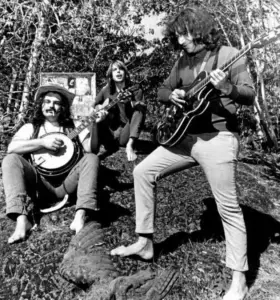
That summer the band rented Rancho Olompali, a big estate north of Novato in Marin County, and turned it into a weekend party for the whole San Francisco scene. Jefferson Airplane, Quicksilver Messenger Service and the Charlatans came out to jam. “Novato was completely comfortable, wide open, high as you wanted to get,” Garcia remembered. Later in the summer they moved to Camp Lagunitas, a former summer camp further into Marin.
They also made their first record. In June a local producer, Gene Estribou, recorded “Stealin'” and “Don’t Ease Me In,” two songs from the jug band years, for his small Scorpio label. Only about 150 copies were pressed, and the single went almost nowhere. At the end of July the band played the Trips Festival in Vancouver, their first shows outside the United States. Owsley’s tapes of those two nights became the bonus disc on the 2017 reissue of the first album.
The Fillmore tapes from that summer, especially July 16, catch the band starting to stretch out. Pigpen fronted most of the set, and the jams on “Dancing in the Street” and “Viola Lee Blues” kept getting longer. Mickey Hart later explained Pigpen’s role: “Pigpen would come out and he’d get people up. We couldn’t do that, I mean Jerry couldn’t do it, Bob couldn’t do it, and Phil certainly couldn’t, but Pigpen could.”
710 Ashbury
In late September 1966 the band moved into 710 Ashbury, a big Victorian rooming house a block off Haight Street. Garcia, Weir and Pigpen lived there, with Lesh and Kreutzmann nearby on Belvedere Street. The house was band office, crash pad and neighborhood landmark all at once, and Scully and Rifkin ran the business from a shared desk.
Each player was developing his own voice. Garcia was still playing his Guild Starfire. He said he had learned lead guitar from records, “Freddie King and B.B. King extensively,” and he took the long, flowing lines of John Coltrane as his model for how a solo should build. Lesh, who had never played bass two years earlier, approached it like a composer. He played counterpoint against the guitar, and that habit would shape the band’s sound for good. Kreutzmann, the only drummer, gave the jams their drive. Weir, still a teenager, sang the country and rock covers and kept finding new places for his rhythm guitar.
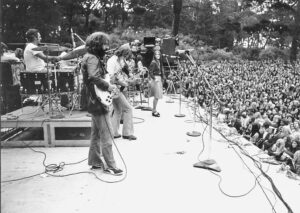
Late in 1966 Warner Bros. signed the band, after Warner executive Joe Smith saw them at the Avalon. The deal was small: a $3,500 advance and a bonus if the album sold well. The band offered Smith LSD before signing, and he said no. On January 14, 1967, the band played the Human Be-In at the Polo Field in Golden Gate Park in front of a crowd estimated at 20,000 to 30,000 people, the largest they had seen. “I’d never seen so many people in my life,” Garcia said.
The First Album
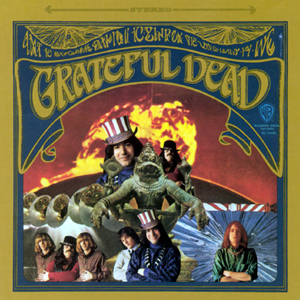
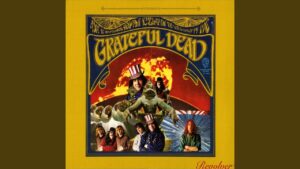
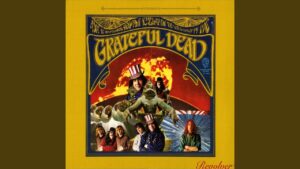
In late January 1967 the band went to RCA’s Studio A in Hollywood with producer Dave Hassinger, who had engineered for the Rolling Stones. They cut most of The Grateful Dead in about four days. Fueled partly by diet pills, they played everything faster than they did onstage. The single, “The Golden Road (to Unlimited Devotion),” was recorded separately at Coast Recorders in San Francisco. It’s credited to McGannahan Skjellyfetti, a made-up name for the whole band.
The album is a snapshot of the 1966 set list: Pigpen’s “Good Morning Little School Girl,” Jesse Fuller’s “Beat It on Down the Line,” the Noah Lewis jug band tune “New, New Minglewood Blues,” Bonnie Dobson’s “Morning Dew,” the old-time “Cold Rain and Snow” and Garcia’s own “Cream Puff War.” The album closes with ten minutes of “Viola Lee Blues,” a 1920s jug band song by Noah Lewis. Garcia said the band recorded it several nights in a row “for as long as we wanted to play it” and kept the take they liked best. “I think our album is honest,” Garcia said. “It sounds just like us. It even has mistakes on it.” Most of the band was less happy. Lesh said that “the only track that sounds at all like we did at the time is Viola Lee Blues,” and Weir found the studio “too sterile of an environment for us because there was nobody there to swing with us.”
Warner Bros. released the album on March 17, 1967. It reached number 73 on the Billboard album chart.
Other Featured Shows
Most early Grateful Dead shows were never taped, and many surviving tapes are fragments. The shows below are the best of what survives. Together they trace the band from a living room in San Jose to the of the Summer of Love.
The list starts with a show nobody recorded. On December 4, 1965, after the Rolling Stones played the San Jose Civic Auditorium, the band set up in a room of a private house known as Big Nig’s for Ken Kesey’s second Acid Test. It was the first time they played as the Grateful Dead. There is no tape, but every later show on this list grew out of that night.
Three months later the band was in Los Angeles, living on Owsley Stanley’s money. The tape from the Danish Center on March 12, 1966 is the best record of those months. Some collectors think it actually comes from the Pico Acid Test a week later. Either way, it catches the early repertoire taking shape: “Viola Lee Blues,” “I Know You Rider,” “Beat It on Down the Line,” “Death Don’t Have No Mercy,” Pigpen’s own “You See a Broken Heart” and a long “In the Midnight Hour.” Parts of it were officially released on Rare Cuts & Oddities 1966.
Back in San Francisco that summer, the band started playing Bill Graham’s Fillmore. July 16, 1966 is the fullest show from that run, nearly two hours and about twenty songs. Pigpen fronts most of it, on “Big Boss Man” and “Good Morning Little School Girl,” and the band stretches “Dancing in the Street” and “Viola Lee Blues” further than before. Two weeks later, on July 29, they played the Trips Festival at the P.N.E. Garden Auditorium in Vancouver, their first show outside the United States. Owsley recorded it himself, and it’s the best-sounding tape of the 1966 band. It’s also the one the band chose for the bonus disc of the 2017 reissue of its first album.
Two shows from the fall track the band settling into the ballrooms. September 16, 1966 at the Avalon Ballroom has an odd history. In 1970 and 1971, MGM released the tapes from that night as the albums Vintage Dead and Historic Dead, without the band’s involvement, and they were many fans’ first chance to hear the 1966 Dead. November 19, 1966 at the Fillmore is the best soundboard from late in the year. It’s a Pigpen showcase, with “Smokestack Lightning,” “The Same Thing,” “I’m a King Bee” and a long “Midnight Hour,” along with Garcia’s “Cream Puff War” and “Cold Rain and Snow,” a song the band would record for its first album two months later.
The 1967 shows follow the band into the spotlight. On January 14, at the Human Be-In in Golden Gate Park, they played for the biggest crowd they had ever seen. The partial tape includes the earliest known Dead version of “Morning Dew” and a “Good Morning Little School Girl” with jazz saxophonist Charles Lloyd sitting in on flute. Winterland on March 18 came the day after the first album was released, on a bill with Chuck Berry. The soundboard is the best record of the band that made the album, with “Morning Dew,” “Viola Lee Blues,” “Cream Puff War,” “The Golden Road” and an early “Me and My Uncle”.
Only two songs from Monterey Pop, on June 18, 1967, are certain to survive on tape: “Viola Lee Blues” and “Cold Rain and Snow.” The show still belongs on the list. The band played between The Who and Jimi Hendrix on the biggest stage of the year and then refused to be filmed, so the tape is all that’s left. The last featured show is Rio Nido Dance Hall on September 3, 1967, Labor Day weekend at a resort on the Russian River. Robert Hunter had just come back for good. The tape has “Alligator,” the first of his lyrics the band performed, and a “Midnight Hour” that runs past thirty minutes. Four weeks later Mickey Hart sat in for the first time, and the five-piece band on these tapes was gone.
Notable Songs from the Haight-Ashbury Years
In 1966 the Grateful Dead were mostly a cover band. Pigpen brought the blues and soul: Sonny Boy Williamson’s “Good Morning Little School Girl,” Slim Harpo’s “I’m a King Bee,” Howlin’ Wolf’s “Smokestack Lightning,” and Wilson Pickett’s “In the Midnight Hour,” which he could stretch for half an hour. Garcia brought songs they’d played as Mother McCree’s and earlier, like Noah Lewis’s “Viola Lee Blues” and Jesse Fuller’s “Beat It on Down the Line,” and turned them into rock and roll. “Viola Lee Blues” became the first true jam vehicle, built up from a jug band shuffle to a wall of noise and back. “Morning Dew,” Bonnie Dobson’s song about the end of the world, entered the set by early 1967 and stayed for almost thirty years.
The originals came slowly. “Caution (Do Not Stop on Tracks)” survived from the Warlocks. Garcia wrote “Cream Puff War,” one of the few Dead songs he wrote alone, words and music. “The Golden Road” was a group-written single, an early blues-influenced tune credited to McGannahan Skjellyfetti (the whole band) that they only played only a handful of times. Hunter’s arrival in 1967 changed the pace. “Alligator,” the first Hunter lyric the band performed, became a long jam that led into “Caution.”
The Summer of Love
By spring 1967 the Haight was national news, and the Dead were its house band. They played free in the Panhandle on Sunday afternoons, and a local TV crew filmed one of the shows in April. At the end of April Robert Hunter, Garcia’s old friend from the Palo Alto folk days, left for New Mexico. From there he mailed the band some lyrics. Lesh and Pigpen set one of them to music as “Alligator,” and Garcia wrote back asking him to come home and write for the band. Two other lyrics in that batch became “China Cat Sunflower” and “St. Stephen.”
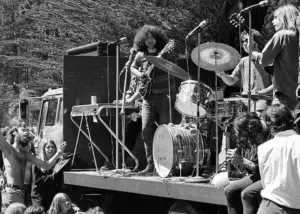
In June the band made its first trip to New York. On June 1 they played a free afternoon show in Tompkins Square Park, and the police shut it down. That set is the first known performance of “Alligator” and of Pigpen’s new showcase, Bobby Bland’s “Turn On Your Lovelight.” Then came about a week and a half at the Café Au Go Go in Greenwich Village. On June 18 they played the Monterey International Pop Festival, between The Who and Jimi Hendrix. They refused to sign the release for the festival film, so they aren’t in it, but critic Michael Lydon wrote that they played “some of the best music of the concert.”
Garcia switched guitars that summer, from the Guild to a Gibson Les Paul with a heavier, singing sustain, and the jams got longer. In July Hunter came back for good, writing lyrics while the band rehearsed.
Around the same time, Kreutzmann met a drummer named Mickey Hart at a Count Basie show at the Fillmore. The two spent the night drumming on parked cars. On September 29, 1967, at the Straight Theater on Haight Street, Hart sat in for the second set. “For nearly two hours we performed the song ‘Alligator,'” Hart said. “After that night, I moved into a closet in Billy and Phil’s apartment on Belvedere and became the sixth member of the Grateful Dead.” Three days later, on October 2, police raided 710 Ashbury and arrested Weir, Pigpen and several others for marijuana.
The practice of never playing the same setlist twice and the emphasis on group interplay over individual showmanship would become the Dead’s defining characteristics. By June 1967, as psychedelic rock was reaching its commercial peak and the Grateful Dead were about to sign to Warner Bros., the essential DNA of the band was already in place. Everything that would follow grew from seeds planted at Ken Kesey’s Acid Tests in 1965. The story of the two-drummer Grateful Dead continues in the Psychedelic Era.