
As the Grateful Dead’s surviving core members pass away, leaving only Bill Kreutzmann and other secondary members from the original band, the era transitions into what Bobby Weir has called “300 years”—the vision that Dead music and Dead community will transcend any individual generation or band configuration. This era represents the final phase of organic transition from the surviving core members to a next generation of musicians and community leaders who never played with Jerry Garcia or the original band, yet carry the Dead’s values, music, and culture forward. The Post-Dead era witnesses the Dead transformed from living band to eternal cultural force—a tradition passed from generation to generation, evolving constantly while maintaining continuity with its origins. It’s an era not yet fully realized but already emerging as tribute bands, jam band communities, and Deadhead culture evolve beyond the original musicians.
January 2026
Bob Weir’s family announced his death on January 10, 2026. He was 78. He had been diagnosed with cancer the previous summer, and the family said he “transitioned peacefully, surrounded by loved ones, after courageously beating cancer as only Bobby could. Unfortunately, he succumbed to underlying lung issues.” The statement also spoke of his hopes for the music: “He often spoke of a three-hundred-year legacy, determined to ensure the songbook would endure long after him.”
“Bob Weir was a little brother to me for almost sixty years,” Mickey Hart wrote. Bill Kreutzmann wrote that “there are so many people who can rightfully say that their life would not have been the same without Bob Weir.” The Grateful Dead’s archivist, David Lemieux, remembered “a guitar player unlike any other, and a songwriter who created some of the most interesting, exciting, and oddly-timed songs in rock history.” In the days around his death, streams of Grateful Dead music rose by more than half, according to Luminate.
Homecoming
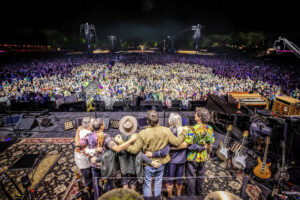
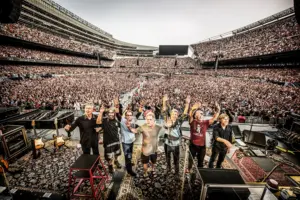
On January 17, San Francisco held a free public memorial, “Homecoming: Celebrating the Life of Bobby Weir.” A procession in the style of a New Orleans funeral went down Market Street to Civic Center Plaza, where about 20,000 people gathered. Joan Baez sang, Nancy Pelosi and Mayor Daniel Lurie spoke, and Mickey Hart led the crowd in the “Not Fade Away” clap. “The songs of our lives are yours now,” Hart told them, “and it’s up to all of us to keep the refrain building.” John Mayer gave the eulogy and led the crowd in “Ripple.” Near the end he returned to Weir’s 300-year idea: “300 years, Bobby, now that’s a plan I can get behind.”
That night at the Warfield, Phil Lesh’s son Grahame led “Howling Wolves,” a tribute concert with musicians from Weir’s bands. Other tributes followed through the year. Mayer remembered Weir at the Grammys in February, and Don Was played Blues for Allah in his honor. In August, Dark Star Orchestra played two nights at the Greek Theatre in Berkeley under the title “The Music Never Stops,” a benefit for the Grateful Dead’s Rex Foundation.
Featured Shows
| Show | Date | City/Country | Venue | Band | Songs | Tour | Fans |
|---|---|---|---|---|---|---|---|
| San Francisco – January 17, 2026 | Jan 17, 2026 | San Francisco, California, United States | The Warfield | Graham Lesh and Friends | 15 | — | — |
| Santa Cruz – August 1, 2026 | Aug 1, 2026 | Santa Cruz, California, United States | Quarry Amphitheater | Joe Russo’s Almost Dead | 13 | — | — |
Who Remains
Bill Kreutzmann, who played the first Warlocks gigs in 1965, turned 80 in May 2026. He is the last surviving member of the founding lineup. Mickey Hart, who joined in 1967, turned 83 that September. Tom Constanten, the band’s keyboard player from 1968 to 1970, and Bruce Hornsby, who played with the band from 1990 to 1992, are also living. Donna Jean Godchaux died in November 2025, and Doug Irwin, who built Jerry Garcia’s guitars Wolf, Tiger and Rosebud, died in March 2026.
Dead & Company played no shows in 2026. Mayer started a weekly two-hour “Grateful Dead Listening Party” on his SiriusXM show in March and spoke openly about not knowing what came next. “Part of the grieving process is to hang it up,” he told Andy Cohen on SiriusXM in August, adding that he was “not swearing it off.”
The Vault
The archive kept releasing shows. Dave’s Picks continued with shows from 1973, 1978 and 1991. In April 2026 the band and nugs.net launched Play Dead, an official streaming app for the vault that adds two new shows every week. In September Rhino released Summer Magic 1985, a 20-CD box of seven shows from the band’s 20th-anniversary summer, including the June 30 show at Merriweather Post Pavilion.
The Songbook
By 2026 the Dead’s songs had a large live afterlife. Grahame Lesh told NPR there are Dead cover bands in “virtually every city in America.” A few groups stand out for their scale. Dark Star Orchestra, formed in 1997, has played more than 3,400 shows, most of them recreations of specific Grateful Dead setlists. Joe Russo’s Almost Dead, formed in 2013, plays the songs with new arrangements. Billy Strings has played them with Weir, Kreutzmann and Dead & Company, and covered “Me and My Uncle” and “Cassidy” for Weir in February 2026. Grahame Lesh’s Terrapin Roadshow carried on the spirit of his father’s Terrapin Crossroads with a summer of outdoor shows in Northern California, Oregon and Colorado.
The band is also studied. The Grateful Dead Archive at UC Santa Cruz holds the band’s papers. The Grateful Dead Studies Association, founded in 2019, publishes a peer-reviewed journal and held its sixth annual conference in February 2026.
Featured Songs
Three Hundred Years
Weir started talking about the long view in his last years. “Right now, my major consideration is what are people gonna say about that or about what I’m thinking or doing in 300 years,” he told CBS Sunday Morning in 2022. In an interview with NPR the same year, he said: “There’s a good chance that these songs are going to be around in 200 or 300 years.” He described the songs as “living critters and they’re visitors from another world.”
Grahame Lesh, who now leads his own bands, told NPR in 2026: “My sense, in terms of the music continuing, is someone is going to be playing it.”