
The Peninsula Scene
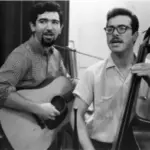
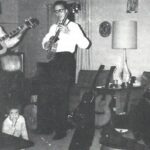
In the early 1960s, Palo Alto, Menlo Park and the Stanford campus had a small bohemian fringe, and it gathered in a handful of places. Kepler’s Books in Menlo Park, opened in 1955 by the pacifist Roy Kepler, was the daytime hangout. Garcia’s girlfriend Barbara Meier remembered the crowd there as poets, musicians, painters, socialists and pacifists, “with a smattering of out and out lunatics.” At night the action moved to the coffeehouses. St. Michael’s Alley in Palo Alto had given Joan Baez an early stage. Rodney Albin opened the Boar’s Head in the summer of 1961, a loft above a San Carlos bookstore that held about forty people. In January 1963 the Top of the Tangent opened above a pizza parlor on University Avenue and quickly became a main stage for the scene.
Next to the Stanford golf course, the cottages of Perry Lane housed writers like Ken Kesey, who had volunteered for drug studies at the Menlo Park veterans’ hospital and turned what he saw there into One Flew Over the Cuckoo’s Nest (1962). On Santa Cruz Avenue, a rambling rooming house called the Chateau threw parties that went on for days. The scene was small enough that everyone eventually met. The musicians who would become the Grateful Dead played together, split up and recombined in it for years before they shared a stage under that name.
Jerry Garcia: Rock and Roll, Art School and a Second Chance
Jerome John Garcia was born on August 1, 1942, in San Francisco’s Excelsior District. Two losses came early. At four he lost most of his right middle finger in a wood-chopping accident with his older brother, Tiff. About a year later his father, Jose, a professional clarinetist and bandleader, drowned on a fishing trip. For his fifteenth birthday in 1957, his mother gave him an accordion. He talked her into trading it at a pawnshop for a Danelectro electric guitar and a small amp, and his stepfather helped him tune it. His first teachers were records by Chuck Berry, Bo Diddley and Elmore James, and in 1959 he played guitar in a high school dance combo called the Chords.
Garcia took art just as seriously. At the California School of Fine Arts (now the San Francisco Art Institute), the painter Wally Hedrick introduced him to Jack Kerouac’s novels and to Big Bill Broonzy’s blues. His Army service ended in December 1960 with a general discharge after repeated AWOLs. On February 20, 1961, Garcia was thrown through the windshield in a high-speed car crash that killed his friend Paul Speegle. “That’s where my life began,” he said later. By the fall he was sleeping in a broken-down car behind the Chateau, until a room opened up inside. Housemates remembered him wandering the halls with a guitar strapped on, his fingers never still.
Garcia’s Bluegrass Apprenticeship, 1961–1963
In the spring of 1961 Garcia met Robert Hunter, and the two began singing folk songs together as Bob and Jerry. Their earliest surviving tape, from Barbara Meier’s sixteenth birthday party on May 26, 1961, sounds nothing like the Grateful Dead: earnest folk-revival standards like “Follow the Drinking Gourd” and “Michael Row the Boat Ashore.” That summer Rodney Albin went to Kepler’s looking for “this guy Jerry Garcia” to fill his new coffeehouse, and Garcia, Hunter and their friend Marshall Leicester soon became Boar’s Head regulars.
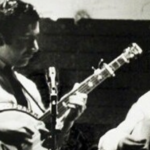
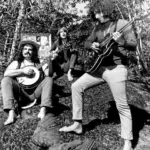
Folk led Garcia to old-time string-band music, and that led him to bluegrass and the five-string banjo. He practiced constantly. According to biographer Dennis McNally, Garcia “woke up in the morning, picked up the guitar, and held onto it until he went to sleep at night.” He never settled into one band for long. Bands were whoever was free that week, and a friend recalled Garcia sometimes naming one on the way to the gig. With Hunter, David Nelson and Joe and Jim Edmiston he was one of the Thunder Mountain Tub Thumpers. With Leicester and fiddler Dick Arnold he traded banjo and guitar in the old-time Sleepy Hollow Hog Stompers. With Hunter, Leicester and Ken Frankel he was a Badwater Valley Boy. Each lineup gave him a different job: lead singer one week, rhythm player the next, banjo out front the week after.
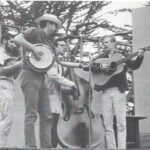
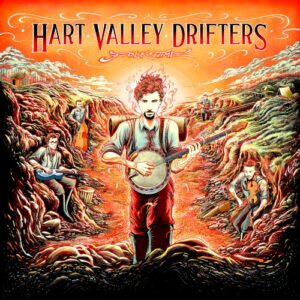
The steadiest of these groups grew out of an introduction Albin made. He had steered David Nelson, a teenager from Belmont, toward bluegrass, and then brought him to meet Garcia and Hunter. In the Hart Valley Drifters, Garcia sang lead and switched between banjo and guitar, Nelson played guitar, Norm Van Maastricht played Dobro, and Frankel moved between fiddle and banjo. Hunter, who could play guitar and mandolin, held down the bass. Stanford student Ted Claire recorded them live at the campus station KZSU in the fall of 1962, and the tape came out in 2016 as Folk Time. Under the name Wildwood Boys, much the same group arrived unannounced at the first Monterey Folk Festival in May 1963. Hunter later recalled arriving late, finding Frankel already holding the mandolin and playing bass instead. Garcia did not win the amateur banjo contest, but the Wildwood Boys won the amateur bluegrass band competition, at the same festival where Bob Dylan made his first West Coast appearance.
Bluegrass gave Garcia more than technique. A bluegrass band trades the lead from instrument to instrument while everyone else backs the soloist, and every player has to listen hard to know when to step forward. That habit of conversation between instruments is easy to hear later in the Dead.
Chasing Bluegrass, 1963–1964
Garcia’s life filled up in 1963. He married Sara Ruppenthal in April, with David Nelson as best man, and their daughter, Heather, was born in December. As Jerry and Sara, the couple played the Top of the Tangent on May 4 for $25 for the whole weekend, with Garcia moving between guitar, banjo, mandolin, autoharp and fiddle on songs like “Deep Elem Blues.” He paid the bills teaching guitar and banjo at Dana Morgan’s Music Store in Palo Alto. On weekends he sometimes played electric bass for money in the Zodiacs, guitarist Troy Weidenheimer’s R&B band, which worked Stanford fraternity parties with Pigpen singing out front. The Zodiacs never rehearsed. Weidenheimer would call a key and start soloing, and Garcia later credited him with showing him how much freedom was available in loose, unrehearsed playing. That summer, in the short-lived Godawful Palo Alto Bluegrass Ensemble with Nelson and Pete Wernick, Garcia played mandolin because Wernick only played banjo.
By late 1963 Garcia wanted a serious bluegrass band, and the Black Mountain Boys came closest. Garcia played banjo, Nelson mandolin and Sandy Rothman guitar, with Eric Thompson, Geoff Levin and Hunter rotating through. Their show at the Top of the Tangent on March 6, 1964, with Jorma Kaukonen opening, is the most complete recording of Garcia’s bluegrass years: three sets and more than 35 songs, including “Dark Hollow” and “Rosa Lee McFall.”
In May 1964 Garcia and Rothman loaded Garcia’s Corvair and drove east to hear bluegrass at its source. They caravanned with the Kentucky Colonels, saw Bill Monroe at Bean Blossom, Indiana, taped the Osborne Brothers in Ohio, and held a tape recorder up to a motel TV in Alabama to capture Jim and Jesse. At a Monroe show in Pennsylvania, Rothman introduced Garcia to a young mandolinist named David Grisman. A few weeks after Garcia drove home, Rothman joined Monroe’s Bluegrass Boys. Garcia did not, and by then he had other things going. That summer he played with Thompson and Jody Stecher as the Asphalt Jungle Mountain Boys, the last of his named bluegrass groups, and he had a jug band, started with a sixteen-year-old named Bob Weir.
Robert Hunter: Bass Player, Novelist, Test Subject
Robert Hunter was born Robert Burns on June 23, 1941, in Arroyo Grande, California, and settled in Palo Alto in 1961 wanting to be a writer, not a musician. At the Chateau he worked on a novel he called The Silver Snarling Trumpet. Music was what he did with Garcia. He sang in their duo, then played mandolin, guitar or bass in whatever bluegrass band needed one, usually the instrument nobody else was holding. Around 1962 he volunteered for paid psychedelic drug experiments at Stanford, later revealed to have been funded by the CIA’s MKULTRA program, and wrote reports on what LSD, psilocybin and mescaline did to his mind.
Hunter dropped out of Garcia’s bands as the bluegrass years ended, and he was not part of the jug band or the electric groups that followed. The partnership came back a few years later through his writing. In New Mexico he wrote the lyrics for “St. Stephen,” “China Cat Sunflower” and “Alligator,” and the band invited him to San Francisco as its lyricist. The folk songs he and Garcia had sung, full of trains, gamblers, murder ballads and hard times, echo through the songs Hunter went on to write.
Bob Weir: The Kid in the Alley
Bob Weir was born Robert Hall Parber in San Francisco on October 16, 1947. Frederic and Eleanor Weir adopted him and raised him in Atherton. School went badly. Undiagnosed dyslexia got him expelled from nearly every school he attended, including Menlo School and the Fountain Valley School in Colorado Springs. The most lasting result of Fountain Valley was his friendship with John Perry Barlow, who would become Weir’s songwriting partner. At fifteen he worked as a ranch hand in Wyoming. He had picked up the guitar at thirteen, after giving up on piano and trumpet, and he later named the Rev. Gary Davis among his early influences.
At thirteen he picked up the guitar and found something that stuck. Like most teenagers in the folk boom, he started out strumming Kingston Trio songs. Then he heard Joan Baez and switched to fingerpicking, practicing until he could play in any key. The Rev. Gary Davis showed him the next step: Davis fingerpicked too, but he ranged all over the neck and left the open strings behind when he went up high. “He was a lot freer on the fretboard,” Weir said. At fifteen he worked as a ranch hand in Wyoming, an experience he drew on decades later for his album Blue Mountain (2016).
On New Year’s Eve 1963, Weir and a friend were wandering the back alleys of Palo Alto looking for a club that would let them in when they heard a banjo. They followed it to Dana Morgan’s Music Store, where Garcia was waiting for students. “Man, this is New Year’s Eve, I don’t think you’ll be seeing anyone,” Weir told him. Garcia opened up the instrument room instead, and they played into the night. Both were hooked on jug band music, and they decided to start a band. “I knew I was onto something here,” Weir recalled.
In Mother McCree’s, the sixteen-year-old played jug, washtub bass and guitar. His job from the very first band was to hold the bottom and rhythm together around Garcia’s lead, and he soon realized, as he put it later, “I wasn’t going to be playing with my fingers for the rest of my life.” He never stopped thinking like a fingerpicker, though, and spoke of “bringing my fingerstyle into my new life as an electric guitarist.” He later compared his rhythm parts to the way jazz pianists like McCoy Tyner comped behind a soloist. That approach, filling the spaces around the lead rather than doubling the bass, became one of the most distinctive parts of the Grateful Dead’s sound.
Ron “Pigpen” McKernan: The Blues Singer
Ron McKernan was born on September 8, 1945, and grew up in a house full of records. His father, Phil, was an R&B and blues disc jockey on Bay Area radio, and when Ron was about thirteen the family moved to the Palo Alto area. That same year he got a cheap used acoustic guitar, and a friend later gave him a harmonica. His father taught him boogie-woogie piano, and he taught himself the rest from the blues 78s he collected. Asked about his heroes in 1966, he named Lightnin’ Hopkins and John Lee Hooker, along with “the more modern guys” like Bobby Bland, Junior Parker and Little Walter. School came last. He went only when he had to and left Palo Alto High School without graduating.
He met Garcia around the Palo Alto folk crowd as a teenager. “I was always bothering Jerry about playing some blues,” he said. Garcia was deep in folk and bluegrass, and Pigpen kept pulling him toward the blues. One night Garcia called him up to sing and play harmonica, and from then on he was the blues singer at Peninsula jam sessions. Robert Hunter remembered him turning up at the Chateau at sixteen, and as “the only guy who could get up on stage and play blues.” Around this time he picked up his nickname, after the grubby Peanuts character.
Pigpen sang wherever he could. He played the Boar’s Head with Rodney Albin and his brother Peter, and he appeared with Garcia on Gert Chiarito’s folk show The Midnight Special on Berkeley’s KPFA. In Troy Weidenheimer’s Zodiacs he sang and blew harp in front of an electric band, working up R&B and blues numbers like “Walking the Dog” and “Searchin’.” By the time he joined Garcia and Weir in Mother McCree’s, he was the one member with no interest in folk purity. That made him the band’s link to electric blues and R&B. In the early Grateful Dead many of the blues covers were his, and Bobby Bland’s “Turn On Your Lovelight,” a song by one of the heroes he named in 1966, became his showcase.
Bill Kreutzmann: The R&B Drummer
Bill Kreutzmann was born in Palo Alto on May 7, 1946. His father warned him there was no money in drumming, and a sixth-grade band teacher told him he couldn’t keep a beat. He started anyway at thirteen, on a borrowed Slingerland kit. His teacher, Lee Anderson, was part of Ken Kesey’s Perry Lane circle, so Kreutzmann was connected to the Peninsula’s bohemian fringe before he ever met Garcia. One day, while he was practicing alone in a building at his high school, Aldous Huxley walked in, listened, and told him he had never heard anything like it.
The music in his parents’ house was R&B. The first record Kreutzmann bought was Ray Charles at Newport, and he played along to it, “learning the drum parts like crazy.” He learned by feel more than by rules. As soon as he stopped thinking about it, he said, he could “memorize the feeling,” not how to play something but how it felt in his body. At Palo Alto High School he drummed for the Legends, the school’s best band, fronted by singer Jay Price and covering James Brown, Junior Parker, Freddie King, “Shout” and “What’d I Say” at YMCA dances, fraternity parties and the local navy airstrip. Playing for dancers taught him to lock a groove and keep a room moving. A 1969 Rolling Stone profile called him the only one of the future Warlocks with rock experience.
Kreutzmann filled in now and then with the Zodiacs, and he taught drums at Dana Morgan’s Music Store, where Garcia taught guitar and banjo. The moment that mattered came at the Tangent, where he sat right in front of Garcia as he played banjo with Mother McCree’s. “I’m going to follow that guy forever,” he thought. Garcia would become his most important teacher. Kreutzmann remembered him patiently walking him through the chord changes of songs, and Kreutzmann’s feel-first, dance-floor drumming, open to whatever the guitars were doing, became the engine of the Grateful Dead.
Phil Lesh: The Classically Trained Composer Next Door
Phil Lesh traced his life in music to one afternoon in 1944, when he was four. His grandmother called him over to hear “the nice music on the radio,” a broadcast of Brahms’s First Symphony, and he was hooked. He started violin at eight and played it for six years, but second violin in youth orchestras felt like “a pretty empty scene.” The trumpet changed that. Studying with Bob Hansen, a Berkeley teacher who brought him into adult orchestras, he went from beginner to playing symphonies in about two years. He transferred to Berkeley High School because it offered the harmony lessons he wanted, and by about 1956 he was writing jazz compositions. In the summer of 1957, at seventeen, he discovered John Coltrane.
At the College of San Mateo, Lesh played trumpet in the jazz band and wrote atonal charts for it. One of them had every section of the band in a different key, which he later described as “like blocks of granite sliding together.” A job in the college library, checking incoming records for damage, let him listen to every new jazz and classical release that came in: Coltrane, Miles Davis, Bartók and Charles Ives. At UC Berkeley in 1961 he met Tom Constanten, and in 1962 the two studied composition with Luciano Berio at Mills College, alongside Steve Reich. In 1963 Lesh wrote Foci, a piece for four orchestras, 123 players and four conductors that was never performed. By 1964, he said, he had composed what he had in him and “didn’t have anything more to say.” He was delivering mail in San Francisco.
His connection to Garcia came through radio. Volunteering as an engineer at Berkeley’s KPFA, Lesh worked on Gert Chiarito’s folk show The Midnight Special and got Garcia booked on it. When Garcia asked him to play bass in 1965, Lesh had never played one. What he brought instead was a composer’s ear and a habit, learned from Coltrane, of hearing how far a band could improvise over a single chord. When he finally picked up the bass he played it as a second melodic voice rather than a timekeeper, and that harmonic reach is a big part of why the Dead’s improvisations could travel as far as they did.
Featured Shows
Crossing Paths
By 1963 these separate paths had started to cross, and most of the crossings ran through Garcia. He knew nearly everyone: the folk crowd at Kepler’s, the bluegrass pickers at the Tangent, the blues kid who kept asking him to play, the students at Dana Morgan’s. The bands that came out of those friendships rarely lasted more than a few months. Each one, though, put two or three future members of the Dead on the same stage, learning how the others played.
The most telling of them was the Zodiacs. Guitarist Troy Weidenheimer led them as an electric R&B band working Stanford fraternity parties. Pigpen sang and blew harp, Garcia sometimes played electric bass, and Kreutzmann occasionally filled in on drums. The Tangent folkies considered electric guitars close to forbidden, and rumors that Garcia was moonlighting in a rock band got around as a minor scandal. The Zodiacs gave him something bluegrass couldn’t: a band with no arrangements, where Weidenheimer called a key and everyone followed him into it. It was also the band that first put Garcia, Pigpen and Kreutzmann in the same circle of players, a couple of years before anyone thought of them as a group.
Other connections were quieter. Pigpen sang blues at the Boar’s Head and joined Garcia on KPFA’s The Midnight Special, the folk show Lesh worked on as an engineer. Lesh drifted through the same Chateau parties where Garcia played. Dana Morgan’s Music Store became a crossroads of its own, with Garcia teaching guitar and banjo and Kreutzmann teaching drums in the same shop. None of it looked like the start of anything. It was a small scene where players borrowed each other’s songs, sat in on each other’s sets, and got used to listening for each other.
The last piece arrived on New Year’s Eve 1963. Sixteen-year-old Bob Weir followed the sound of Garcia’s banjo into Dana Morgan’s, and the two played late into the night. They came out of it planning a jug band, a format loose enough to hold Garcia’s string-band chops, Pigpen’s blues and a teenager still learning to play rhythm. Within a few months the band had a name and a regular stage, and three of the future Grateful Dead were playing in it together.
Featured Releases
Mother McCree’s Uptown Jug Champions
Jug bands were the folk revival’s party music. In the 1920s groups like the Memphis Jug Band had recorded with a jug for a bass, a washboard for drums, and kazoos and harmonica out front. By the early 1960s a new wave led by Boston’s Jim Kweskin Jug Band had brought the sound back. For Garcia the appeal was practical. “You could have a jug band with guys that could hardly play at all,” he said. After years of struggling to find enough good bluegrass players to keep a band together, that mattered.
The band that grew out of the New Year’s Eve jam got its name from Garcia’s oldest partners. According to David Nelson, Hunter came up with “Mother McCree’s” and Nelson added “Uptown Jug Champions.” By spring 1964 it was playing the Top of the Tangent. The earliest show documented with both Garcia and Weir is May 1. Garcia played guitar, banjo and kazoo and sang. Weir played jug, washtub bass and guitar, and Pigpen sang and played harmonica. Dave Parker played washboard, Tom Stone and Mike Garbett filled out the strings, and friends including Nelson, Marshall Leicester and Bob Matthews (later an engineer on Grateful Dead records) rotated in. The songs came from the Kweskin band, the Memphis Jug Band and Pigpen’s blues records.
Featured Songs
| Song | Album(s) | Released | Band | Live Plays | Debut | Original | Lyrics | Guitar | Fans | Recordings |
|---|---|---|---|---|---|---|---|---|---|---|
| Sitting on Top of the World |
 The Grateful Dead
 Folk Time
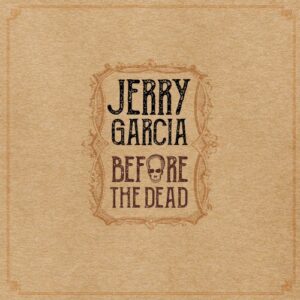
 Before the Dead
|
Mar 17, 1967 | The Grateful Dead | 110 | October 1, 1962 | |||||
| Roving Gambler |
Folk Time
Before the Dead
|
Nov 11, 2016 | Hart Valley Drifters | 1 | October 1, 1962 | |||||
| Shady Grove |
Before the Dead
|
May 11, 2018 | Jerry Garcia | |||||||
| Monkey & The Engineer |
 Reckoning
 Mother McCree’s Uptown Jug Champions (live at the Tangent, Palo Alto Ca, 1964)
|
Jan 2, 1970 | The Grateful Dead | 46 | January 2, 1970 | |||||
| Dark Hollow |
 History of the Grateful Dead, Volume 1: Bear’s Choice
Reckoning
History of the Grateful Dead, Volume 1: Bear’s Choice
Reckoning
|
Feb 14, 1970 | The Grateful Dead | 88 | February 14, 1970 | Bill Browning and His Echo Valley Boys | ||||
| Rosa Lee McFall |
Reckoning
Before the Dead
|
Mar 7, 1964 | The Grateful Dead | 41 | March 7, 1964 | Charlie Monroe | ||||
| On the Road Again |
Reckoning
Mother McCree’s Uptown Jug Champions (live at the Tangent, Palo Alto Ca, 1964)
|
Jan 7, 1966 | The Grateful Dead | 90 | January 7, 1966 | Memphis Jug Band |
In July two Stanford students taped a full set at the Tangent for KZSU. Released in 1999, it is the only known recording of the band. You can hear the future Dead’s repertoire taking shape in it: “Beat It On Down the Line” would land on their first album, “On the Road Again” and “The Monkey and the Engineer” would turn up in their acoustic sets for decades, and Pigpen’s turn on “Ain’t It Crazy” previews the blues frontman he would become.
By the end of 1964, three of the five were in a band together and the other two were close by. Kreutzmann taught drums down the hall from Garcia at Dana Morgan’s. Lesh, who had put Garcia on the radio, was out of ideas as a composer and delivering mail. Jug band gigs were getting scarce, and Pigpen kept pushing for something louder. What happened next is the story of turning a jug band into an electric rock band.