
The Comeback Plan
By the spring of 1976 the Grateful Dead needed to work. Grateful Dead Records and Round Records had run out of money, the distribution deal with United Artists had been spent, and Garcia’s concert film was still unfinished and over budget. As the historian Corry Arnold put it, “the band members were broke.” They still owed United Artists one more album. Ron Rakow, who had run the labels, left that spring after writing himself a check for $225,000 that he believed the band owed him.
The band came back carefully. Instead of booking arenas they might not fill, they picked a few of their biggest markets and played several nights each in old theaters of 2,000 to 3,600 seats. They sold the tickets only by mail order and arranged for local FM stations to broadcast some of the shows. In New York, tickets for the Beacon Theatre went through the band’s fan club, and Jesse Jarnow notes there were “mini-riots” outside.
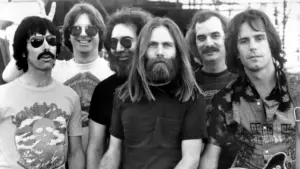
Mickey Hart, who had sat in on October 20, 1974, played on Blues for Allah and played every 1975 show, was now a full member again. With Hart and Kreutzmann, Keith and Donna Godchaux, Garcia, Weir and Lesh, the band had seven members. After rehearsing in the spring at Hart’s barn in Novato and in late May at the Orpheum in San Francisco, they opened the tour on June 3 at the Paramount Theatre in Portland, Oregon.
New Songs and Old Friends
On the first night back, the band opened with “Might As Well,” a Garcia and Hunter song inspired by the 1970 Festival Express train trip across Canada. Weir brought “Lazy Lightnin'” and “Supplication” from his time with Kingfish. The second set opened with “Samson and Delilah,” an old gospel song associated with the Reverend Gary Davis, and the night ended with Garcia’s “The Wheel.” “Dancing in the Street” was back for the first time since 1971, in a new, funkier disco arrangement. The next night they added “Mission in the Rain” from Reflections and brought back “Cosmic Charlie,” which they hadn’t played in years.
On June 9 in Boston the band opened the second set with “St. Stephen,” unplayed since 1971, and later that night played “High Time” for the first time since 1970. By June 12 “Comes a Time” was back too. “Friend of the Devil” was slowed down into the ballad the band would play for the next twenty years.
In his notes on the 1976 tapes, Jesse Jarnow wrote that “mickey’s drums busy up everything & redraws center of band.” The 1976 band has a reputation for slow tempos, especially on Garcia’s ballads, but on a late-May rehearsal tape Jarnow heard “Eyes of the World” come out “faster & busier.” What changed most was the arrangements, which were tighter and more worked out, with fewer open-ended jams. Reviewing the June 1976 box set, Relix’s Jeff Tamarkin heard “a somewhat more disciplined outfit, having shed most of the vestiges of the here-goes-nothin’ psychedelia…”
Featured Songs
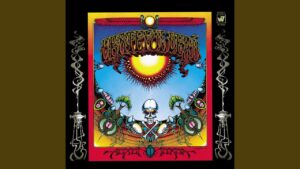

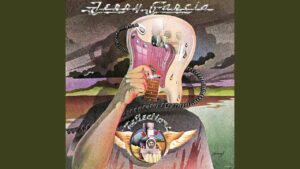
The June Tour
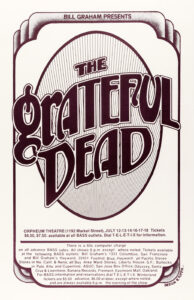
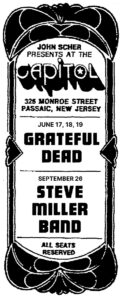
From Portland the band flew east. The tapes of the June theater run are among the most loved of the 1970s. Four Boston Music Hall nights started June 9, the night “St. Stephen” came back. On June 14 and 15 they played the Beacon Theatre, their first concerts in Manhattan since 1972. On June 17 through 19 they played the Capitol Theatre in Passaic, New Jersey, where on June 18 the band ran “St. Stephen” into “Not Fade Away” and back. Then came four nights at the Tower Theatre outside Philadelphia and four at the Auditorium Theatre in Chicago. In July the band came home for six nights at the Orpheum Theatre in San Francisco. The last of them, July 18, was broadcast on KSAN. Many of these shows have since been officially released. In 2020 the June 1976 box set collected five complete shows from Boston, the Beacon and Passaic.
Steal Your Face
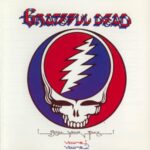
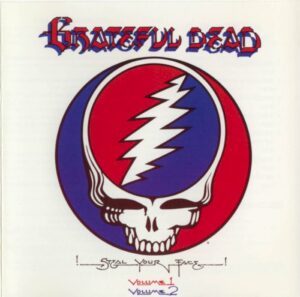
United Artists got its final album on June 26, 1976. Steal Your Face was a double live album drawn from the October 1974 Winterland run, mixed by Phil Lesh and Owsley Stanley from tapes recorded through the Wall of Sound’s canceling microphones. The tapes had technical problems, Donna’s vocals had to be redone in the studio, and the result sounded thin and murky. Lesh called it “a glutinous mud bath of sound, through which any music was scarcely discernible.” Garcia was gentler: “If anyone wants to have some concept of what Phil likes, that’s a good album.” It was the last album on Grateful Dead Records, which folded soon after. Its skull-and-lightning-bolt cover, designed by Owsley and drawn by Bob Thomas, became one of the band’s most famous symbols.
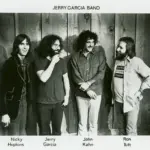
Since early 1976 the Jerry Garcia Band had included Keith and Donna Godchaux along with John Kahn and Ron Tutt, and it played clubs and theaters between Dead tours. Bob Weir left Kingfish after an August 27 show in Berkeley. Diga, by the Diga Rhythm Band that Hart co-led with Zakir Hussain, came out on Round that year.
Featured Releases
Bigger Rooms
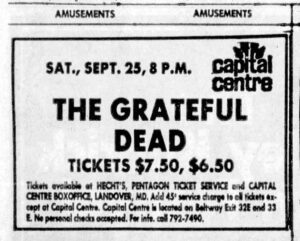
The fall tour, starting in September, played arenas and college fieldhouses: Duke, William & Mary, the Capital Centre outside Washington, Syracuse, Detroit’s Cobo Arena and others. Two of those shows, September 25 at the Capital Centre and September 28 in Syracuse, became Dick’s Picks Vol. 20.
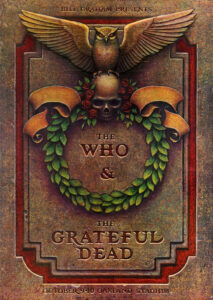
On October 9 and 10 the band opened for The Who at two stadium shows at the Oakland Coliseum, a Bill Graham “Day on the Green.” Between the Dead’s and The Who’s sets, Wavy Gravy promoted his “Nobody for President” campaign. Many of the Who fans had no interest in the Dead, and the shows didn’t sell as well as promoted. Corry Arnold calls them the end of the Grateful Dead as a band that shared bills. From then on, they headlined. Both shows were released on Dick’s Picks Vol. 33. The band finished the tour with two nights at the Shrine Auditorium in Los Angeles.
New Year’s Eve
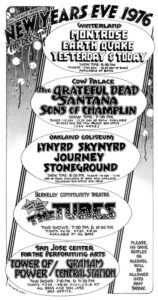
The year ended at the Cow Palace in Daly City on December 31, 1976, the band’s first New Year’s Eve show since 1972, with Santana on the bill and a live KSAN broadcast. At midnight Bill Graham appeared out of a giant hourglass. The second set ran from “Sugar Magnolia” through “Eyes of the World,” “Wharf Rat,” “Good Lovin’,” “Samson and Delilah,” “Scarlet Begonias” and “Help on the Way > Slipknot!” into “Not Fade Away,” and “Morning Dew” closed it. The show was released in 2007 as Live at the Cow Palace: New Year’s Eve 1976.
By then the band had a new record deal. With its own labels gone, it signed in 1976 with Clive Davis’s Arista Records. In February 1977 the band went into the studio with an outside producer, Keith Olsen, to make Terrapin Station. That story belongs to the next era.